Horseback Riding for Adults: What to Know Before You Begin
Learn what horseback riding is really like for adults, how to find the right lessons, what to expect, what gear you need, and how to start safely and confidently.
Most adults who think about riding are not really asking whether they are physically capable of getting on a horse. They are asking whether riding still belongs to them. They want to know whether it makes sense to start now, after years of work, parenting, old injuries, self-consciousness, or the quiet belief that horses are for people who began as children. The clearest answer is yes: horseback riding for adults is entirely realistic, but it only feels realistic when it is described honestly.
The adult version of riding is not about catching up to a missed childhood dream. It is about learning a demanding but accessible skill in the way adults learn best: with structure, context, safety, and patience. A good program does not expect instant confidence. It gives you a calm horse, a clear sequence of skills, and enough repetition for your body and mind to settle. That is the thesis of this article, and everything that follows supports it: adults can start well when riding is approached as a gradual practice rather than a dramatic leap.
What Horseback Riding Actually Feels Like When You Start as an Adult
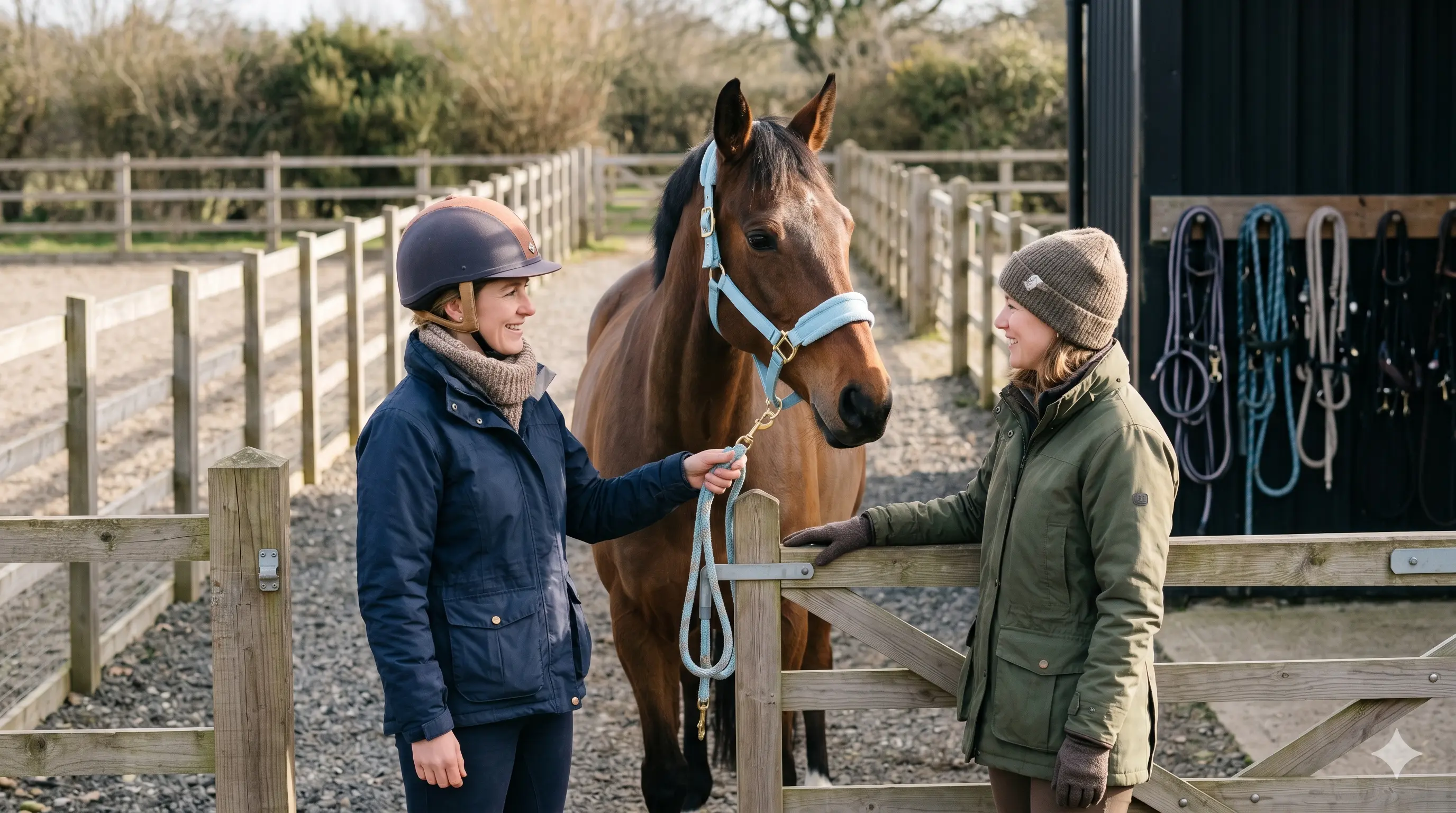
For adult beginners, riding usually feels more subtle and more technical than it looks from the ground. The first surprise is that the challenge is not brute strength. It is coordination. You are learning how to sit in balance while an animal moves underneath you, how to keep your hands steady without becoming rigid, and how to use small cues instead of big reactions. In the first few lessons, even walking can feel mentally full because you are processing posture, breathing, rein contact, leg position, and the horse’s rhythm all at once.
That does not mean the experience is overwhelming forever. It means early riding is immersive. Many adults end their first lesson realizing that it felt less like a thrill ride and more like a conversation they are only beginning to understand. That is one reason the activity can be so absorbing. It demands presence. Research also suggests that riders may develop stronger balance abilities than non-riders, which helps explain why the sport is often associated with posture, body awareness, and coordination over time [1]. Those benefits should not be oversold, but they do reinforce the basic point: riding engages the body in meaningful ways even before a beginner advances to faster gaits.
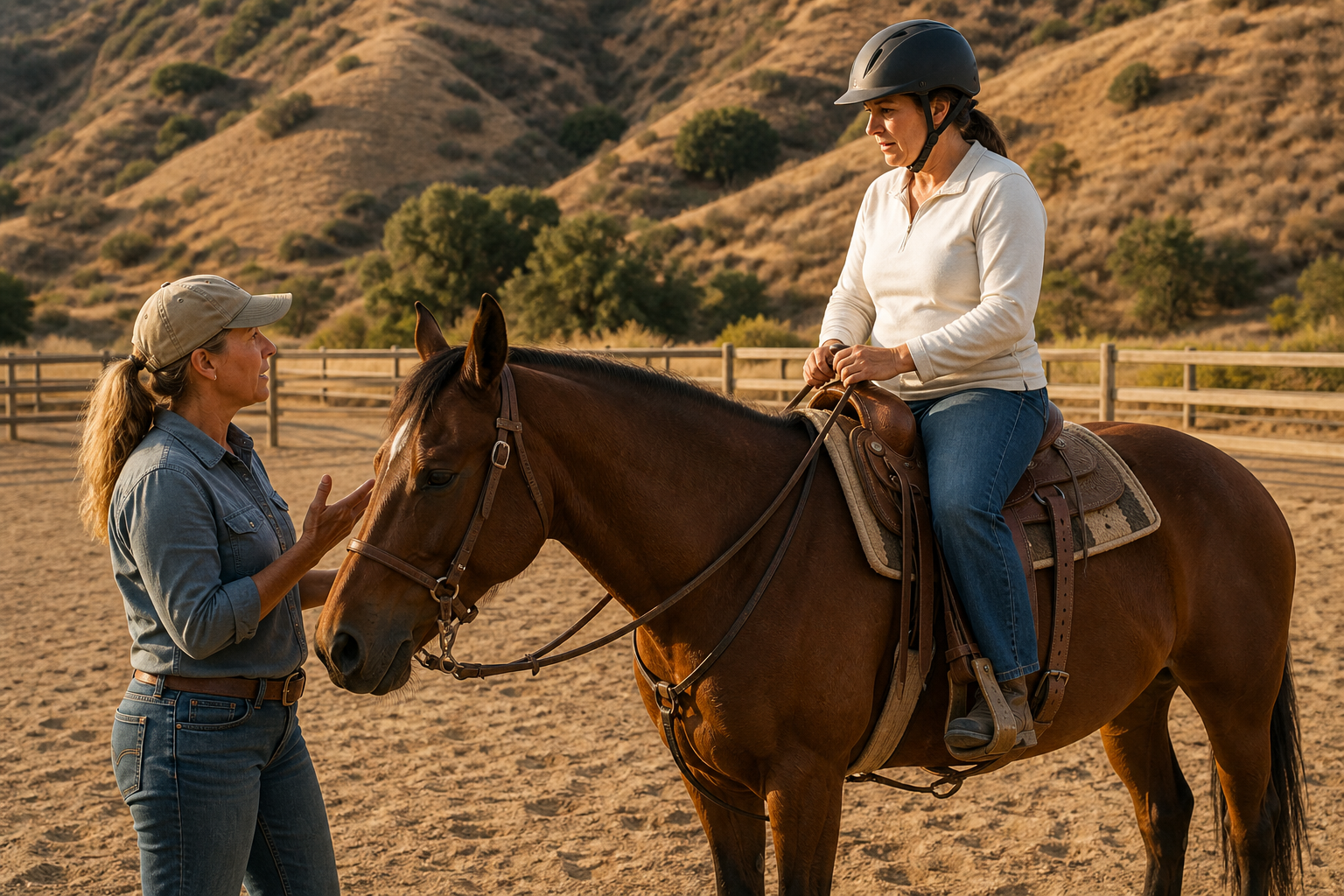
Just as important, the emotional experience changes quickly when the environment is right. Adults often arrive carrying three common fears: fear of falling, fear of looking foolish, and fear of being physically unprepared. Good instruction lowers all three. The lesson becomes manageable once you see that nothing is random, the horse is suitable, and the instructor is paying attention to your comfort as well as your technique. That is why the next step is not about talent. It is about choosing the right place to learn.
The Right Barn Matters More Than Confidence on Day One
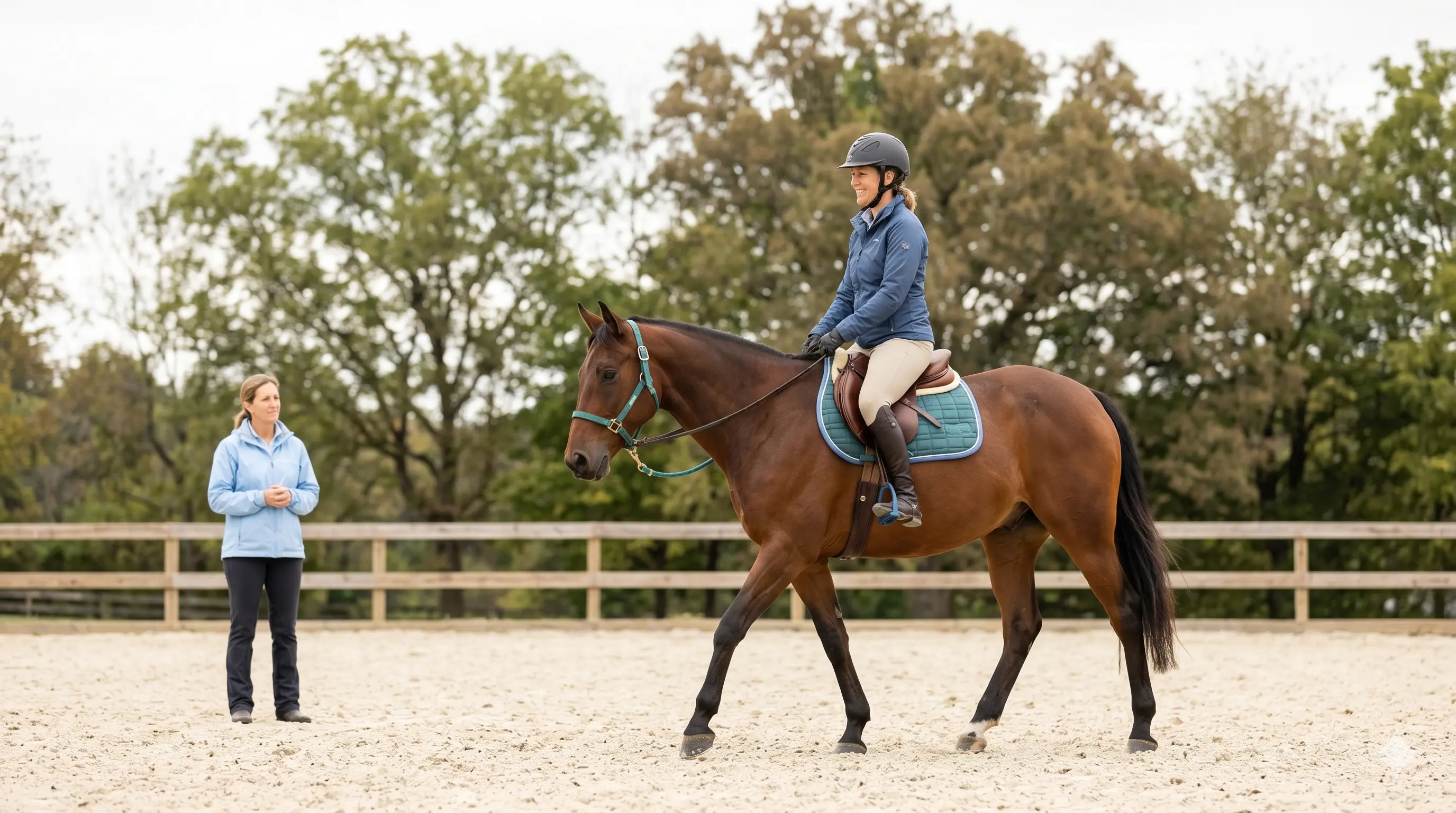
The biggest difference between a good start and a discouraging one is usually not the rider. It is the program. When people search for horseback riding near me for adults, they often focus on geography first. In practice, teaching culture matters more. A nearby barn is only useful if it understands beginner progression and takes adult concerns seriously.
A well-run lesson program should feel calm, organized, and specific. The school horses should look settled and appropriately matched to their riders. Tack should be clean and in sound condition. The instructor should be able to explain how first lessons work, what safety standards are required, and how a rider progresses from basic handling to more independent work. The Certified Horsemanship Association describes certification as independent evaluation against a respected standard and emphasizes safety awareness, communication, and humane horse care [2]. For adult beginners, that is a meaningful signal: you are looking for an environment where trust has been designed into the process.
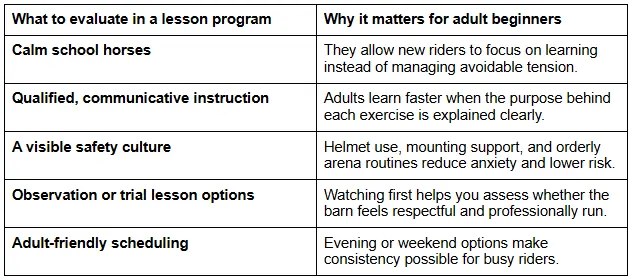
A few red flags are worth naming plainly. If a barn pressures you to prepay before you understand the program, treats helmets as optional, appears chaotic around horses, or cannot explain how it teaches beginners, move on. Adult riders do not need to prove toughness by tolerating poor instruction. They need a place that lets them learn without wasting trust.
The First Ninety Days Are About Familiarity Before Speed
Once the right environment is in place, progress usually comes from repetition rather than intensity. In the first ninety days, the most important change is not whether you can canter. It is whether the barn starts to feel familiar instead of foreign.
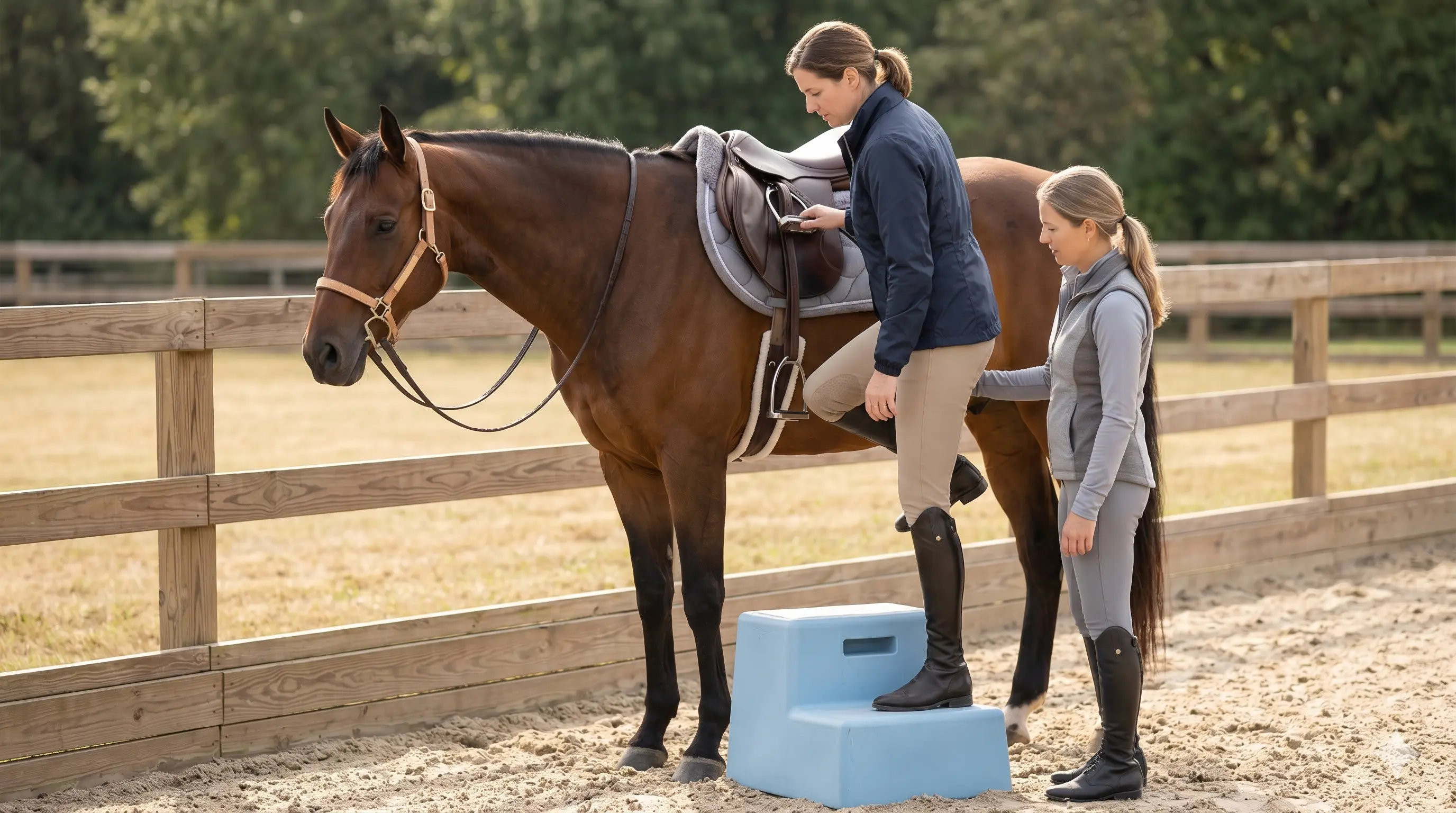
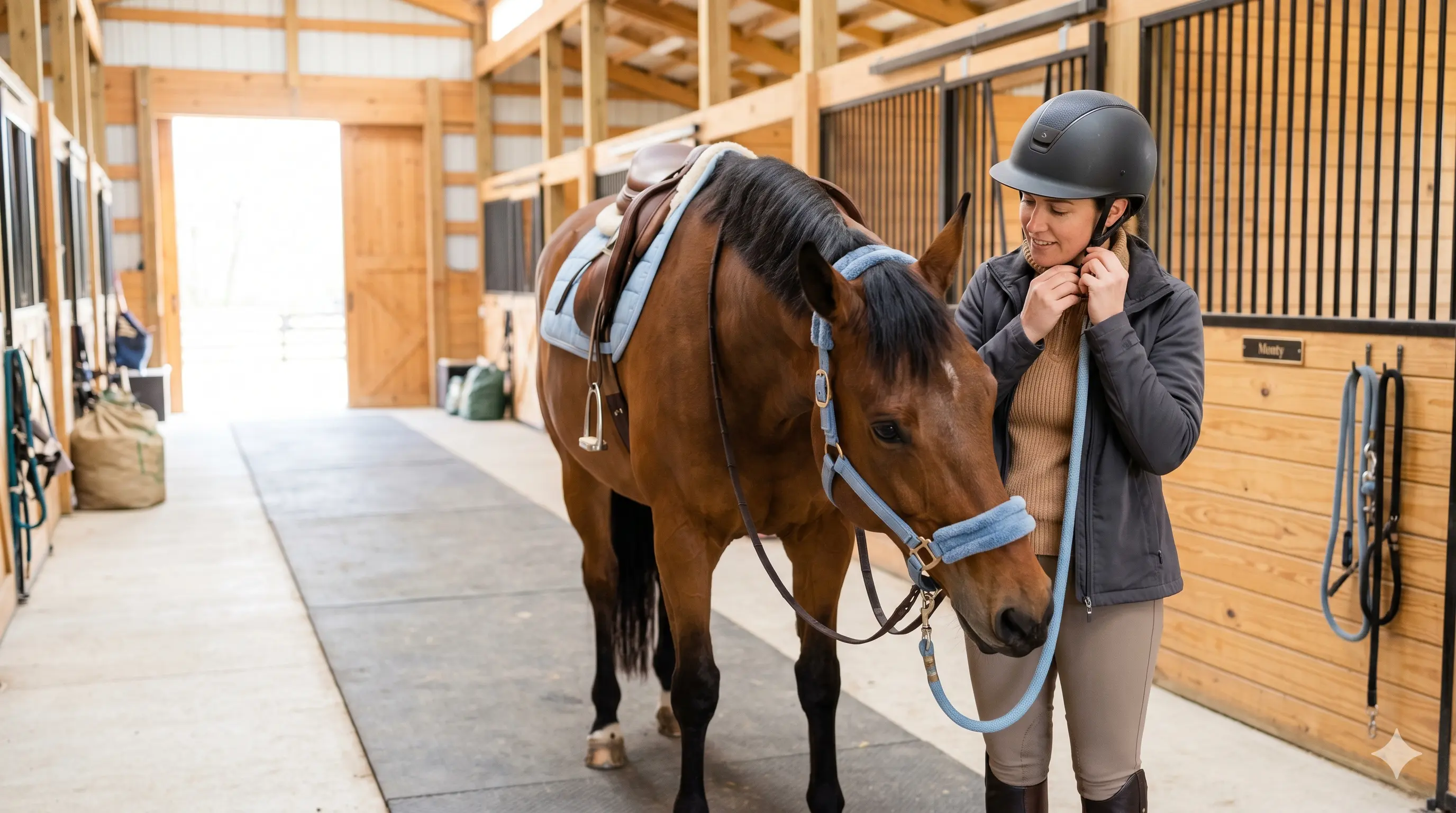
A first lesson often begins on the ground. You may sign waivers, be fitted for a helmet, meet your horse, learn basic grooming steps, and mount with the help of a block. In the saddle, the focus is usually on steering, halting, position, and learning how your body affects the horse.
Over the next few weeks, riders often add walk-trot transitions, posting, circles, and arena etiquette. Later, depending on the program, they may become more independent with grooming and tacking, ride simple patterns, and try early canter work if their basics are secure.
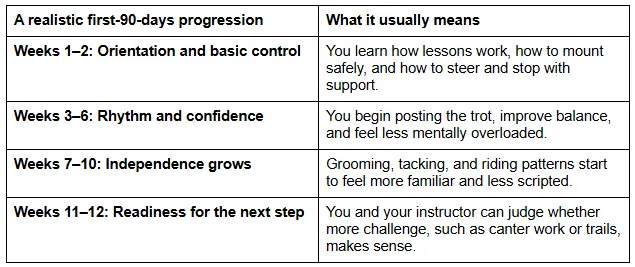
This timeline matters because it reframes success. Adult horseback riding lessons are not effective when they rush beginners toward visible milestones at the expense of security. They are effective when they turn uncertainty into repetition, repetition into comfort, and comfort into skill. Once that rhythm is established, the practical questions become easier to solve.
Starting Is Easier When Cost, Gear, and Scheduling Stay Simple
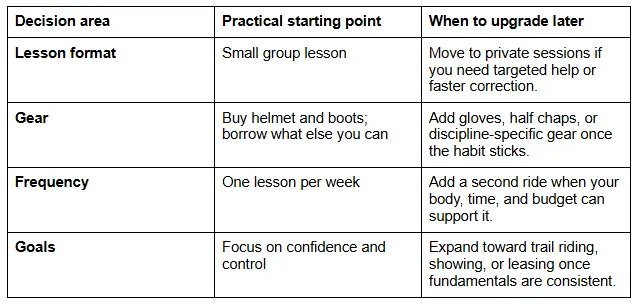
Many adults overestimate what they need before they begin. In reality, the early stage of horseback riding lessons for adults should be logistically simple. A borrowed or newly purchased ASTM/SEI-certified equestrian helmet, a pair of boots with a heel, and comfortable long pants are enough to begin. US Equestrian advises riders to pay attention to recognized equestrian helmet standards and proper fit, making certified head protection a baseline safety requirement rather than an optional upgrade [3].
Cost varies by region and by lesson type, but the most important planning question is not which format looks ideal on paper. It is which format you can sustain. Many adults do well with one lesson per week because that schedule builds continuity without turning riding into another stressful obligation. Group lessons are often more affordable and can be excellent for beginners in organized programs. Private lessons can be useful when a rider wants more tailored feedback or is working through significant anxiety.
A simple planning framework helps:
Progress for Adult Beginners Should Be Measured by Comfort, Not Performance Alone
This is where many late starters either settle into the sport or quietly leave it. If progress is defined only by speed, gait milestones, or comparison to younger riders, adulthood can feel like a disadvantage. If progress is defined by comfort, control, and consistency, adulthood becomes a strength.
Adults often improve in ways that are easy to overlook but central to long-term success. They breathe more steadily at mounting. They recover their balance more quietly after a mistake. They start recognizing the difference between tension and effective effort. They need less mental energy to remember the sequence of grooming, leading, and tack preparation. In other words, they begin to feel at home around horses.
That change matters because riding is not only a sport. It is a relationship with an environment, an animal, and a set of routines that become meaningful through repetition. Many adults eventually discover that what they wanted was not simply to ride at faster gaits. They wanted a practice that asks for attention, builds confidence honestly, and gives them one hour in which their mind has to be exactly where their body is. When that is the goal, beginner horseback riding for adults stops looking like a compromise. It starts looking like a very good fit.

Conclusion
The most useful way to think about horseback riding for adults is not as a late attempt to enter someone else’s world. It is as a structured, learnable practice that works especially well when it respects adult realities. Good barns remove chaos. Good instructors remove guesswork. Realistic expectations remove the pressure to perform before you are ready.
If you are considering starting, the next step is not to ask whether you will be naturally good at it. The next step is to find one reputable barn, observe or book one trial lesson, and judge the experience by clarity, safety, and how comfortable you feel learning there. Adults do not need to arrive fearless. They need a setting that lets confidence become earned.
FAQs
Am I too old to start horseback riding?
No. Many riders begin in adulthood, and the quality of instruction matters far more than starting age.
What is horseback riding actually like for adult beginners?
It is usually more technical and more mentally absorbing than people expect. Early lessons focus on balance, communication, and confidence rather than speed.
How do I find horseback riding lessons near me for adults?
Look for lesson barns, local equestrian associations, tack shops, and recreation programs, then ask about beginner horses, safety rules, and trial lessons.
What should I wear to my first riding lesson as an adult?
Start with a properly fitted helmet, boots with a heel, long pants, and simple clothes that allow movement.
How much do horseback riding lessons for adults usually cost?
Prices vary by region and program type. Group lessons are generally more affordable, while private lessons provide more individualized feedback.
Is Western or English better for adult beginners?
Neither is universally better. The best choice depends on your goals, comfort, and the quality of instruction available near you.
How often should an adult take riding lessons to improve?
For most beginners, one lesson per week is a realistic and effective starting rhythm.
References
[1] Albishi AM, et al. Balance performance among horseback-rider compared to non-horseback-rider women in Saudi Arabia: A cross-sectional study. PMC. https://pmc.ncbi.nlm.nih.gov/articles/PMC11124696/
[2] Certified Horsemanship Association. CHA Certifications. https://cha.horse/cha-certifications/
[3] US Equestrian. Equestrian Helmet Fitting and Safety. https://www.usef.org/media/newsletter/equestrian-weekly/equestrian-helmet-fitting-safety